
S
W E D E S B O R O, New Jersey
Brief
History of
Swedesboro
Immigrants
to New
Netherland 1623-1664
Early Settlers:
Peter
Gunnerson Rambo
Other
Family Forefathers
Other Churches
Holy
Trinity "Old Swedes" Church -
in Wilmington DE
Ancient
swedish-russian-finnish fortress Sveaborg.
A BRIEF HISTORY of The Early Swedes,
TRINITY CHURCH
the Mortenson-VanLeer Log Cabin
and other interesting houses
History abstracted from several sources including:
1) Brochure about Trinity Episocopal "Old Swedes" Church
2) Flyer: New Sweden Park at Trinity Episcopal "Old Swedes" Church
3) Flyer: Old Towne Holiday Evening by the Swedesboro-Woolwich
Historical Society
A Brief History of the Early Swedes in New Jersey
In 1638, the Swedes landed at the present site of Wilmington, Delaware -- establishing Fort Christina and the New Sweden Colony. Ongoing land claim disputes followed between the Swedes/Finns, the Dutch (in 1651 Peter Stuyvesant purchases land from Christina Creek to Bombay Hook) and then the English (in 1680 William Penn, a Quaker, petitioned King Charles II for land north of Maryland).In 1641 acting Governor Peter Ridder acquired land along the eastern shore of the Delaware River, including what is now Salem Couty, to expand the colony. In 1641 Swedish Governor Johan Printz built Fort Elfsborg near Salem, NJ. About this time some of these Swedish settlers who migrated across the Delaware River into what is now New Jersey, found the area greatly suited to farming. The majority of the Finns settled near the Finn's Point Lighthouse and the Swedes in the area that had at one time been called Churchtown.
According to the Pennsville Township Historical Society, "when the early colonists arrived there were three clans of the Lenni-Lenape tribe living in the area along the Delaware River which they called "Shanaigah". Obisquahassit was the name of the Indian Chief who sold land to the settlers. Records of land purchases date back to 1665." The Swedish settlers lived peaceable and agreeably with the Native Americans.
These early settlers used boats to often travel the riverways for commerce, and to attend church at distant places. The Pennsville Historical Society (in Salem Co. NJ) is located at a farm house by "Church Landing," aptly named for the Swedish settlers who used to row, and then later catch the ferry at Church Landing to go to church in Wilmington.
It is known that in 1699 the congregation of Holy Trinity Swedish Lutheran Church purchased a new "canoe" from Hendrick Tussey, who lived at Verdreitige Hook (Bochten) by the Skilpot Creek for 20 shillings and was used to transport church members across the Delaware River. Penns Neck (now Pennsville, Salem Co. N.J.) members went to church by boat. Prior to the building of their own church's, local Swedesboro residents followed this tradition.
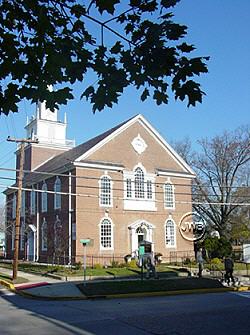
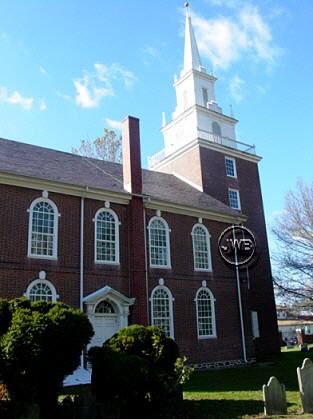
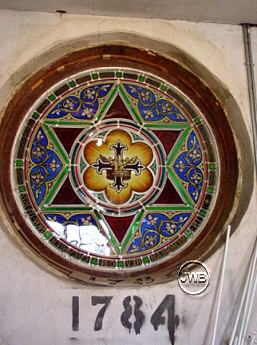
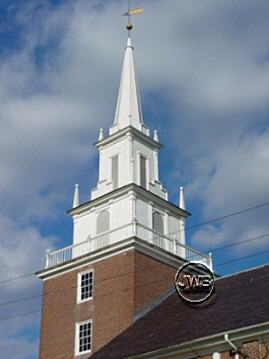
Trinity Episcopal "Old Swedes" Church and Church YardsTrinity Episocopal Church now stands at 208 King's Highway in Swedesboro, New Jersey. This is the oldest deeded church property in the Gloucester County NJ, and the first Lutheran congregation in New Jersey. Their first log church (at "Raccoon") was built in 1703, it being the first Swedish Church in New Jersey and the third in the current United States. That original log cabin church, damaged during the Revolutionary War, was replaced by another--the current Trinity Church of Swedesboro--built in 1784 [see below], and a bell tower and steeple were added in 1839.
In 1976 a small plot of land [near the current Trinity "Old Swedes" Church] overlooking the Racoon creek was dedicated as the New Sweden Park. It marks the exact location of the original log church.
Because the Swedish government stopped sending ministers to America, the congregation became Episcopalian in 1786.
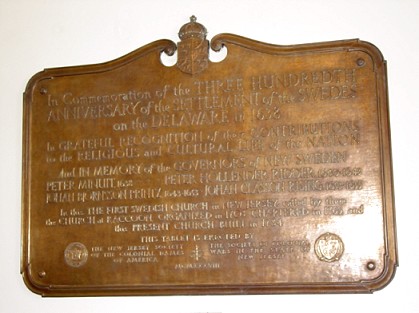
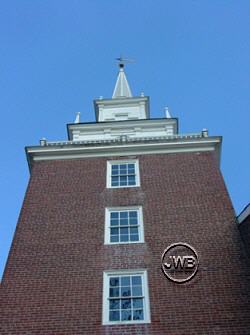
In 1938, H.R.H. Prince Bertil dedicated a bronze tablet on the rear wall in commemoration of the 300th anniversary of the arrival of the Swedes in the Delaware Valley. In 1976 a small plot of land overlooking the Racoon creek was dedicated as the New Sweden Park. It marks the exact location of the original log church.The present church was built in 1784, under the guidance of Rev. Nicholas Collin (a friend of Benjamin Franklin) who designed and helped build the structure. It is closely patterned on the Georgian designs of Christ Church & St. Peter's in Philadelphia. Structural engineers see similiarities between the Trinity Church Tower and Independence Hall. Built within 10 years of each other, the towers have an internal pyramid design, with sloping columns connected to horizontal beams by wooden brackets called "ship's knees."
According to the Trinity Episcopal Church's web site: "The first settled pastor in South Jersey was Isreal Holg Fluviander who was assigned as Garrison priest at Ft. Elfsborg (near Salem) in 1643. But after the departure of Governor Printz and the loss of New Sweden to the Dutch, the Swedish and Finnish settlers in what was called "West Jersey" had to worship on the other side of the Delaware. With the renewal of the Church of Sweden's mission on the Delaware in 1697, the pastor of Gloria Dei, Wicaco, ministered to the needs of those living at Sveaborg (Swedesboro) and north of the Racoon Creek. But the passage across the river was treacherous and impossible in bad weather. Finally in 1701 Hans Stahl, a lay member of Holy Trinity, Wilmington, DE, was appointed as schoolmaster and lay preacher for the Swedes and Finns of New Jersey. He began the first regular services, but the pastors in Christina and Wicaco opposed the establishment of a Jersey parish until the debts for the new church buildings on the western side of the Delaware were satisfied." For more information on the past and continuing history of this church, visit the Trinity Episcopal Church's web site.The church closed in 1992 due to the failure of 8 roof trusses. It has been restored through New Jersey Historic Trust matching grants and the efforts or the congregation and community. Current members include direct descendants of Dalbo, Homan and Rambo, original church founders.
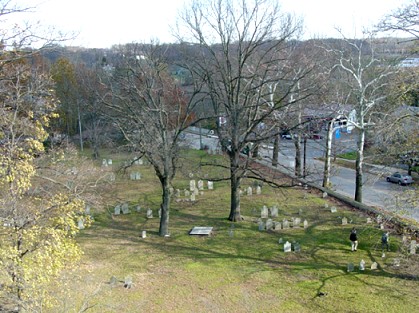
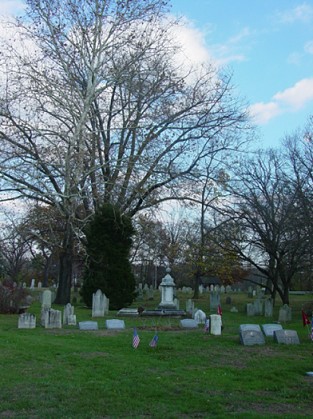
Adjacent to Trinity "Old Swedes" Episcopal Church is a graveyard containing the remains (many unmarked) of the early Swedes, and other local residents who first settled there in the late 17th century. A book written in 1910 ("Swedesboro Yesterday and Today" by Egge the earliest tombstone was that of Jonas Jones who died in 1721. In addition you can still find the graves of Revolutionary War soldiers: Col. Robert Brown, Col. Bodo Otto, Col. Thomas Heston, and Capt. John Daniels.
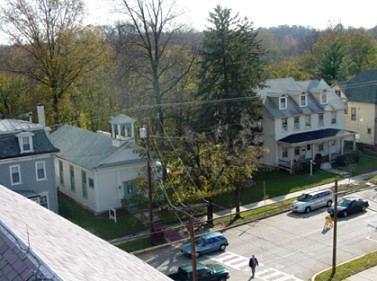
Trinity Church's "new" cemetary, purchased around 1818 from Robert Tittermary, is found two blocks away on Church Street. That newer cemetery is the resting place of other local citizens, some from the Civil war, and including a governor (Charles C. Stratton).The Parish House of Trinity Church (located across the street from the church) was built in 1854, and is still used for the Church Sunday School and various functions of the Parish. A ceiling medallion and chandelier exist in the original portion of the building. There have been two additions to the building to enlarge it. When a shingle roof was installed in 1998, the original cedar shakes were discovered under the existing roof. The ridge beam is a rough hewn timber. The building was financed by the Women's guild of the Church as a place to have fundraising events, a tradition that continues today. It is the site of colonia teas and wool spinning demonstrations during the annual tour sponsored by the Swedesboro-Woolwich Historical society.
Mortenson-VanLeer aka "Schorn" Log Cabin
This log cabin was originally located on the Grand Sprute Plantation (mentioned below), and was moved to its present location on the edge of the Trinity Church cemetery property.
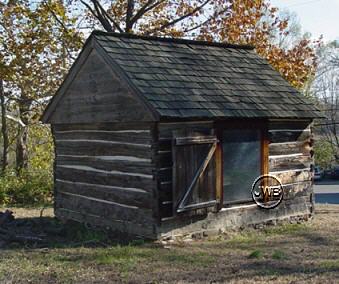
The Mortenson-VanLeer Log Cabin, located on the Trinity Episcopal Church property, dates back to the 1600's, and is an example of Swedish-Finnish cabin structure, with cedar logs, carved joints and lime mortar caulking. It may have been a temporary dwelling, granary, small animal shelter or possibly used as a station in the Underground Railway system. Morton Mortenson purchased the land known as Grand Sprute Plantation (at Raccoon Creek) from Andrew Robeson. Morteson was the grandfather of John Morton, a signer of the Declaration of Independance. There were many other owners of this cabin over the years: Archer, Van Leers, Blacks and Schorns.The Schorn descendants (four Schorn daughters, descendants of Caroline Damminger and Florentine Schorn are/were: Geraldine Bird, Miriam Bower, Carolyn Uhlig, and Patricia Longacre) deeded the cabin to the Gloucester County Historical Society.
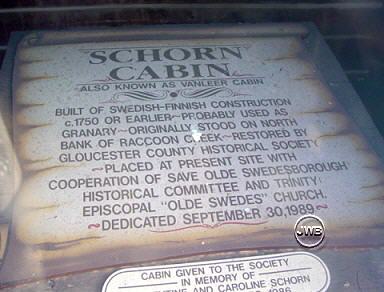
Trinity Church offered space in New Sweden Park for its relocation,
and it was dedicated at that spot on Sept. 30, 1989.
THE TALMAN HOUSE - located at 1324 Kings Highway in Swedesboro, this house was completed in July 1906 and is reputed to be a "Sears House." The original home on the site was moved by owner Albert R. Talman in February 1906 to Water Street. Talman made and sold shoes from the home. He later moved to the shop to the site of the present "Victor's Merchandise." The house was purchased in 2001 by Marilyn Sue Williams and John Reeves Carpes who continue this restoration work.
"CASHIER" JOHN C. RULON HOUSE at 1428 Kings Highway in Swedesboro. This house is a work in progress with restoration more than 95% complete. Listed on the New Jersey and National Register of Historic Places in November 2000. A brick home with deep windowsills. The bricks are said to have been fired on Capt. John Schock's farm outside of town on the Raccoon Creek. The house was built in two parts and dates back to the early 1800's. During the Civil War, Army personnel were housed there are indicated by papers found in the attic. The house features beautiful antique chandeliers, a light in the newel post, huge rooms with a center hall and three level stairway. Has a unique and unusual small sink in the dining room used by Drs. Fithian and Garrison. Artifacts and progress photos of the restoration were on display during a recent house tour, as well as items from the Swedesboro-Woolwich Historical Society. It is currently owned by Edie and Al Rohrman.
OTHER BUILDINGS OF INTEREST in Swedesboro NJ
At 1214 Kings Highway can be found the Poinsett House, build in 1892 by a relative of Dr. Joel Poinsett for whom the poinsettia plant was named. It is a finely maintained example of a Victorian House.
The Samuel Dyer House at 1320 Kings Highway (adjacent to the Talman House) was built in 1812.
The Swedesboro Library built in 1915 was once the William Davidson Home, then the Post Office then the Swedesboro Trust Company. It was donated to the borough by Mr. Edgar Hurff, for the use as a Public Library.
SWEDES Inn aka Washington Tavern, aka Old Swedes Inn, aka The Ford Hotel located at 306 Kings Highway, Swedesboro
Links:
- Trinity Episcopal "Old Swede's" Church - History
- TRINITY EPISCOPAL "OLD SWEDES" CHURCH - NJ Historic Trust
- Churches of New Sweden - Colonial Swedes
- Colonial Swedes- Links from the Trinity Church page
- Biography
of John Morton - signer of the Declaration of Independence
=====================================================
P H O T O G R A P H S
taken by Janice Brown in November 2003
ALL of the photographs on this page are the personal property of
Janice Brown and may not be used for any purpose without
express written permission
photo by J. Brown
Photograph of Trinity Episcopal "Old Swede's" Church
Swedesboro New Jersey
(facing east)
photo by J. Brown
Photograph of Trinity Episcopal "Old Swede's" Church
Swedesboro New Jersey
(facing west, looking at the entrance)
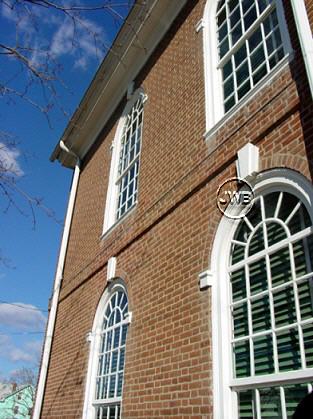
photo by J. Brown
Photograph of Trinity Episcopal "Old Swede's" Church
Swedesboro New Jersey
(left side of building)
photo by J. Brown
Photograph of Trinity Episcopal "Old Swede's" Church
Swedesboro New Jersey
(right side, taken from graveyard)
photo by J. Brown
Photograph of Trinity Episcopal "Old Swede's" Church
Swedesboro New Jersey
(plaque inside church)
photo by J. Brown
Photograph of Trinity Episcopal "Old Swede's" Church
Swedesboro New Jersey
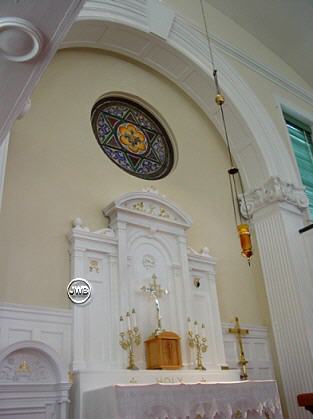
(altar inside church)
photo by J. Brown
Photograph of Trinity Episcopal "Old Swede's" Church
Swedesboro New Jersey
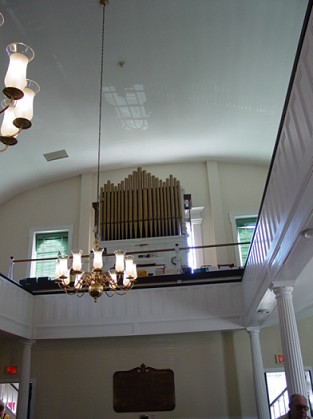
(facing back of church and organ loft)
photo by J. Brown
Photograph of Trinity Episcopal "Old Swede's" Church
Swedesboro New Jersey
(close up, back side, of altar stained glass window)
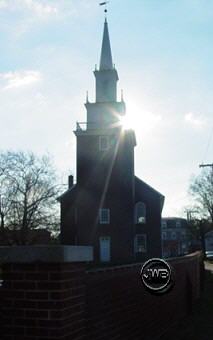
photo by J. Brown
Photograph of Trinity Episcopal "Old Swede's" Church
Swedesboro New Jersey
(bell tower)
photo by J. Brown
Photograph of Trinity Episcopal "Old Swede's" Church
Swedesboro New Jersey
(side view of bell tower)
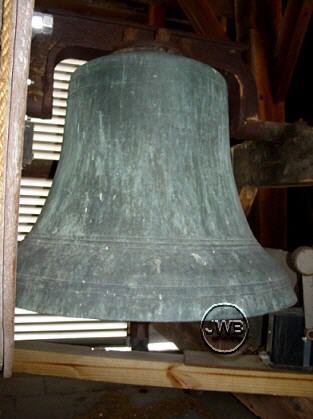
photo by J. Brown
Photograph of Trinity Episcopal "Old Swede's" Church
Swedesboro New Jersey
(bell in bell tower)
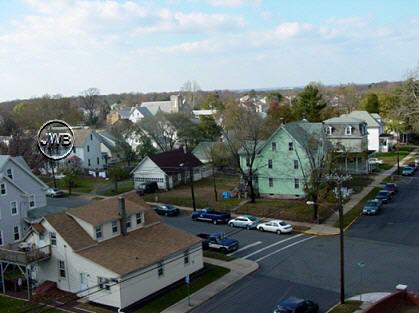
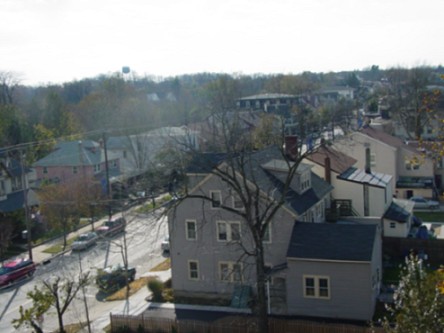
photo by J. Brown
Photograph of Trinity Episcopal "Old Swede's" Church
Swedesboro New Jersey
(taken from bell tower, looking southwest)
photo by J. Brown
Photograph of Trinity Episcopal "Old Swede's" Church
Swedesboro New Jersey
(taken from bell tower, looking north into cemetery)
photo by J. Brown
Photograph of Trinity Episcopal "Old Swede's" Church
Swedesboro New Jersey
(taken from bell tower, looking east at parish house)
photo by J. Brown
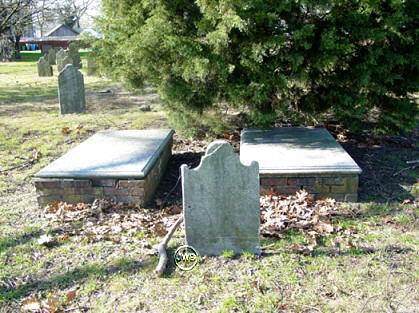
Photograph of Trinity Episcopal "Old Swede's" Church - graveyard
Swedesboro New Jersey
(Resting place of Bodo Otto - left flat stone)
LEARN MORE ABOUT BODO OTTO
photo by J. Brown
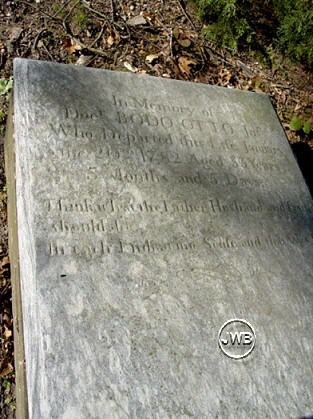
Photograph of Trinity Episcopal "Old Swede's" Church - graveyard
Swedesboro New Jersey
(Resting place of Bodo Otto-see inscription)
Inscription:
In Memory of
Doctor BODO OTTO Jr
Who departed this life
January 25th 1782, aged 33 Years, 5 Months and 5 Days
"Think what the Father, Husband and Friend should be
and in each endearing sense that was he."
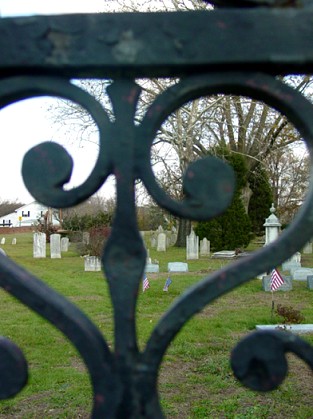
photo by J. Brown
Photograph of Trinity Episcopal "Old Swede's" Church - graveyard
Swedesboro New Jersey
(taken from the south side of the church)
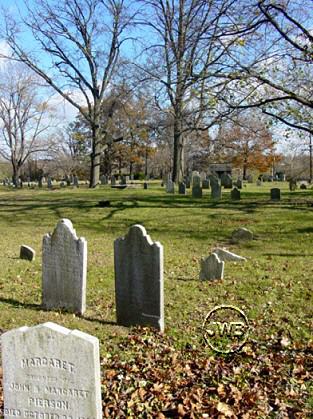
photo by J. Brown
Photograph of Trinity Episcopal "Old Swede's" Church - graveyard
Swedesboro New Jersey
(taken near the main entrance of the church)
photo by J. Brown
Photograph of the Mortenson-VanLeer "Schorn" Log Cabin
at Trinity Episcopal "Old Swede's" Church
Swedesboro New Jersey
photo by J. Brown
Photograph of the Mortenson-VanLeer Log Cabin's plaque (inside cabin)
at Trinity Episcopal "Old Swede's" Church
Swedesboro New Jersey
Reference | Photographs | Contact | Site Map
Copyright © 2003-2020 | Janice A. Brown | All rights reserved.