Zion United Methodist Church
Rev. Richard L. Workman
242 Kings
Highway
Clarksboro, NJ 08020
(856) 423-2000
Map
and Directions
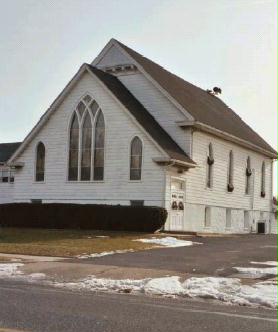
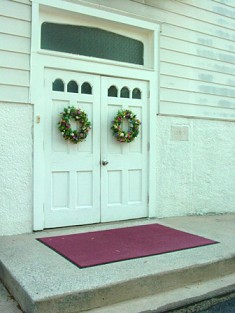
Photograph
of Zion Methodist Church, Clarksboro, NJ
Photograph from the East Greenwich
Master Plan, 2004
History
of the Zion United Methodist Church
Although the history of the Zion United Methodist Church (from
"East Greenwich Township Centennial" booklet, by Laura
Getsinger) states that "the first Methodist Episcopal Church
built in the state of New Jersey was at Berkley [Mt. Royal], in
1766. Here Methodism began--in East Greenwich Township, which
was then part of Greenwich Township,"--this is not completely
accurate.
In fact, the original deed of the church
at Berkley [located on King's Highway within the current St.
Peter's burial ground], to Edward Evans and eleven of his followers
by Uriah Paul, on November 29, 1770 specifically states, that
"the said half acres of ground...for the use of an English
Church to be built and Burying Ground." What is known
indeed is that after a few years of being without a preacher,
Methodist preachers were invited to this early church, with a
congregation made up mostly of those who followed the Church of
England, along with Methodists and Quakers.
In
1772, Robert Blackwell was appointed missionary here by the Church
of England. He was appointed the manager of this church in 1773.
In June of 1774, the church managers agreed upon several regulations,
including "that from this day forward no person shall
preach in this House but the Clergy of the Church of England,"
and offering to refund subscriptions to the Methodist or Quaker
portion of the congregation.
Since the Methodists were not recognized, the congregation split;
part remaining Methodist; part remaining with the Church of England.
Records found in St. Peter's parish minutes state the rules that
were set up concerning the use of the chapel by the Methodist
Society, for its meetings.
Two of the managers, Joshua Paul and Jeffrey Chew, remained with
the Methodists, and refused to serve as managers and withdrew.
This gave complete control to the Church of England, and the Methodists
were not allowed to preach here. The property, however, could
not be transferred until a settlement could be arranged with some
of the Society This meeting was held September 13, 1774.
On March 9, 1775, it was found necessary to adopt less liberal
terms for the repayment of money to those who were dissatisfied,
and to order that "No person shall preach in this house but
the clergy of the Church of England." Soon after this action,
the managers of the Methodist's Society built at church at Berkley
[Mount Royal], about one mile from the present Zion Methodist
Church. No date of this building can be found, and some believe
it was located near Green's Lumber Yard.
Because
of the rapid growth of a class at Clonmell Gibbstown, the class
at Berkley faded. Benjamin Weatherby, a local deacon of the Society,
as tradition has it, placed this frame church on wheels, and
moved it to Clonmell,
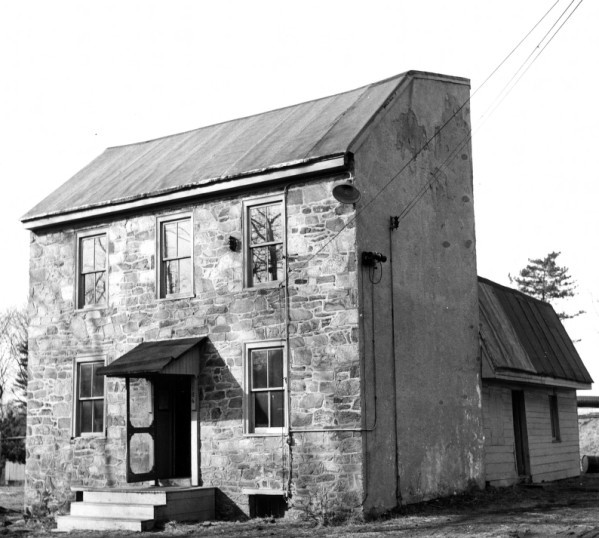
in the middle of the night. [SEE PHOTO BELOW].
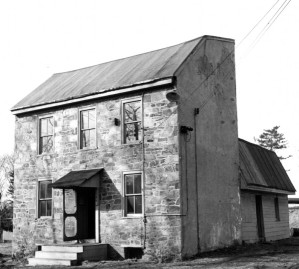 Photograph
courtesy of the Hagley Museum & Library
Photograph
courtesy of the Hagley Museum & Library
Do not reuse without their written permission.
The Old Stone House, Repauno Works--Originally the
Mullen Farm House before Repauno began operations on the
site.
"On
27 Aug 1789, Robert Newell, John Vanneman, Samuel Lodge,
Paul Bright, Edward Barton, Michael Turner and John Drummond
of the Methodist Episcopal Society of Clonmell bought one-quarter
acre of land for five shillings for a Preaching House and
graveyard. A local deacon organized people to put a house
on wheels and moved it to Gibbstown. The church is the
frame building behind the stone Mullen farm house."
My thanks to Dave Drummond for pointing out the location
of this photograph, and to Hagley Museum & Library for
allowing me to use it here. |
Whether
the Class worshipped in the building that was moved, or if they
held their meetings in private homes has not been determined,
but the remaining members did attend a great revival meeting at
Bethel, Hurffville. History and facts about Methodism are missing
until 1793 when a deed was given to Joseph Adams for the Old
Stone Church at Oak Grove, near Swedesboro. This is now the
oldest standing Methodist Church in South Jersey.
After the removal of the Mount Royal Chapel, nothing of Methodism
in Clarksboro is known until 1832, when the Rev. William H. Stevens,
in charge of the Salem Circuit, began to preach in the schoolhouse
at Clarksboro. This school was located on the north side of the
present church addition.
In September 1832, a class was formed at Clarksboro. Gideon Zierns
was a member, as were Lewis Rice, Job Lawrence, Kesiah Lawrence,
Peter Hughes, Ann Hughes, Joseph D. Green, Mary Green, William
Kessler, Eliza Kessler, Thomas Locke, William Jordan, William
Cowgill, Mary Ann Hughes, and Rosanne Early. Rice who had been
a member of Carpenter's Landing [Mantua] was appointed leader.
Services were held regularly on Sunday afternoons and the preaching
was done by local men. These meetings were held in the home of
Job Lawrence, a class leader and one of the first trustees of
the church. Mr. Lawrence also donated the ground on which the
church was finally built.
November 23, 1832, the Methodist Society, or Congregation of Christians
of Clarksboro, met at the home of Job Lawrence. Excerpts from
these minutes state: "On motion of Nathaniel Turner, the
Rev. Walter Burrows was called to the chair, and John C. Eastlack
chosen secretary. Joseph D. Green, Nathaniel Turner, John C. Eastlack,
Lewis Rice and Job Lawrence were chosen trustees of the M.E. Church
at Clarksboro and assume and take it upon themselves the name
of 'Zion'." These trustees met at the office of Samuel Sailer
at Clarksboro on Nov. 30th to take the oath of office. The deed
and election was recorded in the Clerk's office in Woodbury on
May 8, 1833.
The Society then felt the need for a church building. Subscribers
were obtained and the building was started April 1833. The church
was finished and dedicated September 1834 with the Rev. Bartholomew
Wood preaching the sermon.
The Rev. William H. Stevens was pastor and Rev. John Walker was
junior preacher. December 14, 1833 Rev. Stevens died of consumption,
and Rev. Walker became preacher with Rev. Robert Luttor became
junior preacher.
In 1883, the Board appointed a building committee to erect a new
church. Built at a cost of $4500 the building was dedicated on
December 6, 1883, and this is the building the Congregation worships
in today.
In 1899, it was decided to build a new parsonage. The old parsonage
was sold and the house moved to Weatherby Avenue, Clarksboro.
Stained glass windows were added to the church in 1928, and the
front steps were replaced with a narthex.
In 1953, an addition was added to relieve overcrowding in Sunday
School classes. In 1974, it became necessary to have a larger
sanctuary, and a wall was knocked out to seat approximately 50
more persons. The stairway was changed and the interior of the
church was completely remodeled and renovated. In 1981 the minister
was Rev. John J. Hamilton. Jr.
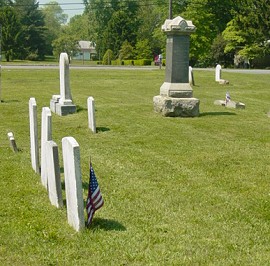
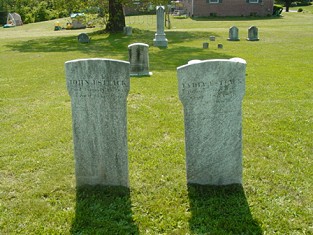
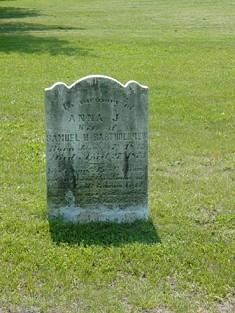
ZION UNITED METHODIST CHURCH CEMETERY
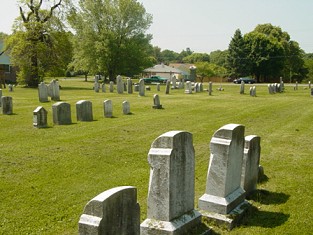
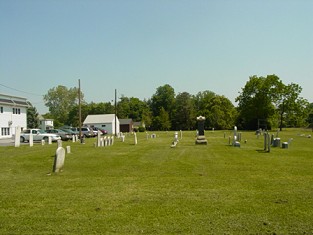
In 1859, the church graveyard was erected. The cemetery is located
directly behind the church, and is accessible from Shady Lane
Road. See photographs below.
See the list of some veteran's buried
in this cemetery.